Home

Animal Taxa
  Order Index
  Families A-Z
  Genus A-Z
  » Species A-Z
  Common Names A-Z
  All Families
  All Common Names

Plant Taxa
Semiochemicals
Floral Compounds
Semiochemical Detail
Semiochemicals & Taxa
Synthesis
Control
References

Forum
Contribute
Guide
Register
Donation
 
 
Print
Email to a Friend
« Previous SpeciesEpicauta vittata    Next SpeciesEpicometis hirta »

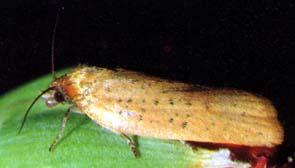
Semiochemicals of Epichoristodes acerbella, the South African carnation tortrix

Phylum:  Arthropoda
Subphylum:  Uniramia
Class:  Insecta
Order:  Lepidoptera
Family:  Tortricidae
Subfamily:  Tortricinae
Genus:  Epichoristodes
Tribe:  Archipini
Author:  Walker
¦
Control
Discuss this Species
  Edit this Record
  Help
Image: Google | Yahoo
Host: Google | Yahoo
Biology: Google | Yahoo
Distribution: Google | Yahoo
¦


Semiochemical(s):

  Dalla Guda C  1984  Ann. Ist. Sper. Frut.  15:  
    Z11-14Ac    66.7 ¦Relative ratio of the component¦   ¦(*) indicates that compound is active¦   P
¦Category of the chemical signal
A -   Attractant
Al -   Allomone
K -   Kairomone
P -   Pheromone
Sy -   Synomone¦
 
L
¦Source of the chemical signal
F -   Female
H -   Host (could be of plant or animal origin)
L -   Lure
M -   Male
M&F -   Male and Female
S -   Solider
Q -   Queen
W -   Worker¦
 
¦Amount
pg -   Picogram
ng -   Nanogram
µg -   Microgram
mg -   Milligram
g -   Gram¦
 
 
    Z9-14Ac    16.7 ¦Relative ratio of the component¦   ¦(*) indicates that compound is active¦    
¦Source of the chemical signal
F -   Female
H -   Host (could be of plant or animal origin)
L -   Lure
M -   Male
M&F -   Male and Female
S -   Solider
Q -   Queen
W -   Worker¦
 
¦Amount
pg -   Picogram
ng -   Nanogram
µg -   Microgram
mg -   Milligram
g -   Gram¦
 
 
    Z11-14OH    8.3 ¦Relative ratio of the component¦   ¦(*) indicates that compound is active¦    
¦Source of the chemical signal
F -   Female
H -   Host (could be of plant or animal origin)
L -   Lure
M -   Male
M&F -   Male and Female
S -   Solider
Q -   Queen
W -   Worker¦
 
¦Amount
pg -   Picogram
ng -   Nanogram
µg -   Microgram
mg -   Milligram
g -   Gram¦
 
 
    Z9-14OH    8.3 ¦Relative ratio of the component¦   ¦(*) indicates that compound is active¦    
¦Source of the chemical signal
F -   Female
H -   Host (could be of plant or animal origin)
L -   Lure
M -   Male
M&F -   Male and Female
S -   Solider
Q -   Queen
W -   Worker¦
 
¦Amount
pg -   Picogram
ng -   Nanogram
µg -   Microgram
mg -   Milligram
g -   Gram¦


  Sehnal F  1982  Frust. Entomol.  2: 113   
    Z11-14Ac    ¦Relative ratio of the component¦   ¦(*) indicates that compound is active¦   P
¦Category of the chemical signal
A -   Attractant
Al -   Allomone
K -   Kairomone
P -   Pheromone
Sy -   Synomone¦
 
¦Source of the chemical signal
F -   Female
H -   Host (could be of plant or animal origin)
L -   Lure
M -   Male
M&F -   Male and Female
S -   Solider
Q -   Queen
W -   Worker¦
 
¦Amount
pg -   Picogram
ng -   Nanogram
µg -   Microgram
mg -   Milligram
g -   Gram¦
 
Italy 
 
  Lalanne-Cassou B  1980  C.R. Hebd. Sean. Acad. Sci.  291: 845   
    Z11-14Ac    64 ¦Relative ratio of the component¦   ¦(*) indicates that compound is active¦   P
¦Category of the chemical signal
A -   Attractant
Al -   Allomone
K -   Kairomone
P -   Pheromone
Sy -   Synomone¦
 
F
¦Source of the chemical signal
F -   Female
H -   Host (could be of plant or animal origin)
L -   Lure
M -   Male
M&F -   Male and Female
S -   Solider
Q -   Queen
W -   Worker¦
 
¦Amount
pg -   Picogram
ng -   Nanogram
µg -   Microgram
mg -   Milligram
g -   Gram¦
 
 
    Z9-14Ac    8 ¦Relative ratio of the component¦   ¦(*) indicates that compound is active¦    
¦Source of the chemical signal
F -   Female
H -   Host (could be of plant or animal origin)
L -   Lure
M -   Male
M&F -   Male and Female
S -   Solider
Q -   Queen
W -   Worker¦
 
¦Amount
pg -   Picogram
ng -   Nanogram
µg -   Microgram
mg -   Milligram
g -   Gram¦
 
 
    Z11-14OH    26 ¦Relative ratio of the component¦   ¦(*) indicates that compound is active¦    
¦Source of the chemical signal
F -   Female
H -   Host (could be of plant or animal origin)
L -   Lure
M -   Male
M&F -   Male and Female
S -   Solider
Q -   Queen
W -   Worker¦
 
¦Amount
pg -   Picogram
ng -   Nanogram
µg -   Microgram
mg -   Milligram
g -   Gram¦
 
 
    Z9-14OH    2 ¦Relative ratio of the component¦   ¦(*) indicates that compound is active¦    
¦Source of the chemical signal
F -   Female
H -   Host (could be of plant or animal origin)
L -   Lure
M -   Male
M&F -   Male and Female
S -   Solider
Q -   Queen
W -   Worker¦
 
¦Amount
pg -   Picogram
ng -   Nanogram
µg -   Microgram
mg -   Milligram
g -   Gram¦


Reference(s):

Dalla Guda, C., Capizzi, A., Arsura, E., and Spinelli, P. 1984. Results of four years of research and experiment on the sex pheromone of Epichoristodes acerbella (Walker). Ann. Ist. Sper. Frut. 15:1-16.
 
Sehnal, F., Janda, V., Jr., and Nemec, V. 1982. Identification of (Z)-11-tetradecen-1-yl acetate as a component of Epichoristodes acerbella sex pheromone. Frust. Entomol. 2:113-120.
 
Lalanne-Cassou, B., and Frérot, B. 1980. Analysis of pheromonal secretion of South African carnation tortrix, Epichoristodes acerbella (Walk.) (Lepidoptera: Tortricidae). C. R. Hebd. Sean. Acad. Sci., Ser. D. 291:845-848.
 
 
Citation: El-Sayed AM 2008. The Pherobase: Database of Insect Pheromones and Semiochemicals. <http://www.pherobase.com>.
©2003-2008 The Pherobase - Extensive Database of Insect Pheromones and Semiochemicals. Ashraf M. El-Sayed
Page created on 3-May-2008