Home

Animal Taxa
  Order Index
  Families A-Z
  Genus A-Z
  » Species A-Z
  Common Names A-Z
  All Families
  All Common Names

Plant Taxa
Semiochemicals
Floral Compounds
Semiochemical Detail
Semiochemicals & Taxa
Synthesis
Control
References

Forum
Contribute
Guide
Register
Donation
 
 
Print
Email to a Friend
« Previous SpeciesZeiraphera canadensis    Next SpeciesZeiraphera griseana »

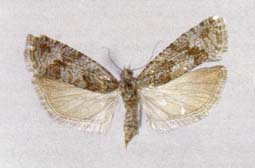
Semiochemicals of Zeiraphera diniana, the Larch budmoth

Phylum:  Arthropoda
Subphylum:  Uniramia
Class:  Insecta
Order:  Lepidoptera
Family:  Tortricidae
Subfamily:  Olethreutinae
Genus:  Zeiraphera
Tribe:  Eucosmini
Author:  Guenée
¦
Control
Discuss this Species
  Edit this Record
  Help
Image: Google | Yahoo
Host: Google | Yahoo
Biology: Google | Yahoo
Distribution: Google | Yahoo
¦


Semiochemical(s):

  Guerin PM  1984  Experientia  40: 892   
    E9-12Ac    0.5 ¦Relative ratio of the component¦   * ¦(*) indicates that compound is active¦   P
¦Category of the chemical signal
A -   Attractant
Al -   Allomone
K -   Kairomone
P -   Pheromone
Sy -   Synomone¦
 
F
¦Source of the chemical signal
F -   Female
H -   Host (could be of plant or animal origin)
L -   Lure
M -   Male
M&F -   Male and Female
S -   Solider
Q -   Queen
W -   Worker¦
 
ng
¦Amount
pg -   Picogram
ng -   Nanogram
µg -   Microgram
mg -   Milligram
g -   Gram¦
 
cembran pine 
    E11-14Ac    0.005 ¦Relative ratio of the component¦   ¦(*) indicates that compound is active¦    
¦Source of the chemical signal
F -   Female
H -   Host (could be of plant or animal origin)
L -   Lure
M -   Male
M&F -   Male and Female
S -   Solider
Q -   Queen
W -   Worker¦
 
¦Amount
pg -   Picogram
ng -   Nanogram
µg -   Microgram
mg -   Milligram
g -   Gram¦
 
 
    12Ac    0.05 ¦Relative ratio of the component¦   ¦(*) indicates that compound is active¦    
¦Source of the chemical signal
F -   Female
H -   Host (could be of plant or animal origin)
L -   Lure
M -   Male
M&F -   Male and Female
S -   Solider
Q -   Queen
W -   Worker¦
 
¦Amount
pg -   Picogram
ng -   Nanogram
µg -   Microgram
mg -   Milligram
g -   Gram¦


  Guerin PM  1984  Experientia  40: 892   
    E11-14Ac    0.5 ¦Relative ratio of the component¦   * ¦(*) indicates that compound is active¦   P
¦Category of the chemical signal
A -   Attractant
Al -   Allomone
K -   Kairomone
P -   Pheromone
Sy -   Synomone¦
 
F
¦Source of the chemical signal
F -   Female
H -   Host (could be of plant or animal origin)
L -   Lure
M -   Male
M&F -   Male and Female
S -   Solider
Q -   Queen
W -   Worker¦
 
ng
¦Amount
pg -   Picogram
ng -   Nanogram
µg -   Microgram
mg -   Milligram
g -   Gram¦
 
larch 
    E9-12Ac    ¦Relative ratio of the component¦   ¦(*) indicates that compound is active¦    
¦Source of the chemical signal
F -   Female
H -   Host (could be of plant or animal origin)
L -   Lure
M -   Male
M&F -   Male and Female
S -   Solider
Q -   Queen
W -   Worker¦
 
¦Amount
pg -   Picogram
ng -   Nanogram
µg -   Microgram
mg -   Milligram
g -   Gram¦
 
 
    14Ac    0.1 ¦Relative ratio of the component¦   ¦(*) indicates that compound is active¦    
¦Source of the chemical signal
F -   Female
H -   Host (could be of plant or animal origin)
L -   Lure
M -   Male
M&F -   Male and Female
S -   Solider
Q -   Queen
W -   Worker¦
 
¦Amount
pg -   Picogram
ng -   Nanogram
µg -   Microgram
mg -   Milligram
g -   Gram¦
 
 
    16Ac    0.1 ¦Relative ratio of the component¦   ¦(*) indicates that compound is active¦    
¦Source of the chemical signal
F -   Female
H -   Host (could be of plant or animal origin)
L -   Lure
M -   Male
M&F -   Male and Female
S -   Solider
Q -   Queen
W -   Worker¦
 
¦Amount
pg -   Picogram
ng -   Nanogram
µg -   Microgram
mg -   Milligram
g -   Gram¦


  Vrkoc J  1979  Anz. Schädlingskd. Pfl. Umwelt  52: 129   
    E9-12Ac    ¦Relative ratio of the component¦   ¦(*) indicates that compound is active¦   A
¦Category of the chemical signal
A -   Attractant
Al -   Allomone
K -   Kairomone
P -   Pheromone
Sy -   Synomone¦
 
L
¦Source of the chemical signal
F -   Female
H -   Host (could be of plant or animal origin)
L -   Lure
M -   Male
M&F -   Male and Female
S -   Solider
Q -   Queen
W -   Worker¦
 
¦Amount
pg -   Picogram
ng -   Nanogram
µg -   Microgram
mg -   Milligram
g -   Gram¦
 
Czech Republic 
 
  Baltensweiler W  1978  Mitt. Schweiz. Entomol. Ges.  51: 133   
    E9-12Ac    ¦Relative ratio of the component¦   ¦(*) indicates that compound is active¦   A
¦Category of the chemical signal
A -   Attractant
Al -   Allomone
K -   Kairomone
P -   Pheromone
Sy -   Synomone¦
 
L
¦Source of the chemical signal
F -   Female
H -   Host (could be of plant or animal origin)
L -   Lure
M -   Male
M&F -   Male and Female
S -   Solider
Q -   Queen
W -   Worker¦
 
¦Amount
pg -   Picogram
ng -   Nanogram
µg -   Microgram
mg -   Milligram
g -   Gram¦


  Roelofs WL  1971d  Experientia  27: 1438   
    E11-14Ac    ¦Relative ratio of the component¦   ¦(*) indicates that compound is active¦   P
¦Category of the chemical signal
A -   Attractant
Al -   Allomone
K -   Kairomone
P -   Pheromone
Sy -   Synomone¦
 
F
¦Source of the chemical signal
F -   Female
H -   Host (could be of plant or animal origin)
L -   Lure
M -   Male
M&F -   Male and Female
S -   Solider
Q -   Queen
W -   Worker¦
 
¦Amount
pg -   Picogram
ng -   Nanogram
µg -   Microgram
mg -   Milligram
g -   Gram¦


Reference(s):

Guerin, P.M., Baltensweiler, W., Arn, H., and Buser, H.-R. 1984. Host race pheromone polymorphism in the larch budmoth. Experientia. 40:892-894.
 
Vrkoc, J., Skuhravy, V., and Baltensweiler, W. 1979. Field investigation on the reaction of the spruce form of the grey larch bud moth, Zeiraphera diniana Gn. (Lep., Tortricidae) to sex attractants. Anz. Schädlingskd. Pfl. Umwelt. 52:129-130.
 
Baltensweiler, W., Priesner, E., Arn, H., and Delucchi, V. 1978. Evidence for different sexual attractants used by the larch form and the cembran pine form of the grey larch bud moth (Zeiraphera diniana Gn.). Mitt. Schweiz. Entomol. Ges. 51:133-142.
 
Roelofs, W.L., Cardé, R., Benz, G., and von Salis, G. 1971d. Sex attractant of the larch bud moth found by electroantennogram metthod. Experientia. 27:1438-1439.
 
 
Citation: El-Sayed AM 2008. The Pherobase: Database of Insect Pheromones and Semiochemicals. <http://www.pherobase.com>.
©2003-2008 The Pherobase - Extensive Database of Insect Pheromones and Semiochemicals. Ashraf M. El-Sayed
Page created on 3-May-2008