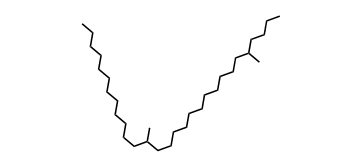
| 5,17-Dimethylnonacosane |
| Formula: | C31H64 |
| CAS#: | |
| MW: | 436.84 |
[MS]
[ Kovats ]
|
|
Species utilize 5,17-Dimethylnonacosane in its chemical communication system
| Hymenoptera, Braconidae, Braconinae | |
| Bracon cephi |
P
¦Category of the chemical signal
| A - | Attractant |
| Al - | Allomone |
| K - | Kairomone |
| P - | Pheromone |
| Sy - | Synomone¦ |
|
¦(*) indicates that compound is active¦
|
|
| Bracon lissogaster |
P
¦Category of the chemical signal
| A - | Attractant |
| Al - | Allomone |
| K - | Kairomone |
| P - | Pheromone |
| Sy - | Synomone¦ |
|
¦(*) indicates that compound is active¦
|
|
| |
| Hymenoptera, Figitidae, Eucoilinae | |
| Leptopilina victoriae |
P
¦Category of the chemical signal
| A - | Attractant |
| Al - | Allomone |
| K - | Kairomone |
| P - | Pheromone |
| Sy - | Synomone¦ |
|
¦(*) indicates that compound is active¦
|
|
| |
| Isoptera, Heterotermitidae, Heterotermitinae | |
| Reticulitermes banyulensis |
P
¦Category of the chemical signal
| A - | Attractant |
| Al - | Allomone |
| K - | Kairomone |
| P - | Pheromone |
| Sy - | Synomone¦ |
|
¦(*) indicates that compound is active¦
|
|
| Reticulitermes grassei |
P
¦Category of the chemical signal
| A - | Attractant |
| Al - | Allomone |
| K - | Kairomone |
| P - | Pheromone |
| Sy - | Synomone¦ |
|
¦(*) indicates that compound is active¦
|
Iberian subterranean termite |
| Reticulitermes lucifugus |
P
¦Category of the chemical signal
| A - | Attractant |
| Al - | Allomone |
| K - | Kairomone |
| P - | Pheromone |
| Sy - | Synomone¦ |
|
¦(*) indicates that compound is active¦
|
Italian subterranean termite |
| Reticulitermes lucifugus corsicus |
P
¦Category of the chemical signal
| A - | Attractant |
| Al - | Allomone |
| K - | Kairomone |
| P - | Pheromone |
| Sy - | Synomone¦ |
|
¦(*) indicates that compound is active¦
|
|
| |
| Coleoptera, Cerambycidae, Cerambycinae, Callidiini | |
| Callidiellum rufipenne |
P
¦Category of the chemical signal
| A - | Attractant |
| Al - | Allomone |
| K - | Kairomone |
| P - | Pheromone |
| Sy - | Synomone¦ |
|
*
¦(*) indicates that compound is active¦
|
Japanese cedar longhorned beetle |
| |
| Hymenoptera, Formicidae, Formicinae, Formicini | |
| Cataglyphis bombycinus |
P
¦Category of the chemical signal
| A - | Attractant |
| Al - | Allomone |
| K - | Kairomone |
| P - | Pheromone |
| Sy - | Synomone¦ |
|
¦(*) indicates that compound is active¦
|
Saharan silver ant |
| |
| Hymenoptera, Formicidae, Formicinae, Lasiini | |
| Lasius emarginatus |
P
¦Category of the chemical signal
| A - | Attractant |
| Al - | Allomone |
| K - | Kairomone |
| P - | Pheromone |
| Sy - | Synomone¦ |
|
¦(*) indicates that compound is active¦
|
Central European bicolored ant |
| |
| Hymenoptera, Formicidae, Myrmicinae, Formicoxenini | |
| Temnothorax nylanderi |
P
¦Category of the chemical signal
| A - | Attractant |
| Al - | Allomone |
| K - | Kairomone |
| P - | Pheromone |
| Sy - | Synomone¦ |
|
¦(*) indicates that compound is active¦
|
|
| Temnothorax racovitzai |
P
¦Category of the chemical signal
| A - | Attractant |
| Al - | Allomone |
| K - | Kairomone |
| P - | Pheromone |
| Sy - | Synomone¦ |
|
¦(*) indicates that compound is active¦
|
|
| Temnothorax recedens |
P
¦Category of the chemical signal
| A - | Attractant |
| Al - | Allomone |
| K - | Kairomone |
| P - | Pheromone |
| Sy - | Synomone¦ |
|
¦(*) indicates that compound is active¦
|
|
| Temnothorax unifasciatus |
P
¦Category of the chemical signal
| A - | Attractant |
| Al - | Allomone |
| K - | Kairomone |
| P - | Pheromone |
| Sy - | Synomone¦ |
|
¦(*) indicates that compound is active¦
|
|
| |
| Hymenoptera, Formicidae, Myrmicinae, Myrmicini | |
| Myrmica lobicornis |
P
¦Category of the chemical signal
| A - | Attractant |
| Al - | Allomone |
| K - | Kairomone |
| P - | Pheromone |
| Sy - | Synomone¦ |
|
¦(*) indicates that compound is active¦
|
|
| Myrmica rubra |
P
¦Category of the chemical signal
| A - | Attractant |
| Al - | Allomone |
| K - | Kairomone |
| P - | Pheromone |
| Sy - | Synomone¦ |
|
¦(*) indicates that compound is active¦
|
Common red ant |
| Myrmica scabrinodis |
P
¦Category of the chemical signal
| A - | Attractant |
| Al - | Allomone |
| K - | Kairomone |
| P - | Pheromone |
| Sy - | Synomone¦ |
|
¦(*) indicates that compound is active¦
|
Common elbowed red ant |
| Myrmica specioides |
P
¦Category of the chemical signal
| A - | Attractant |
| Al - | Allomone |
| K - | Kairomone |
| P - | Pheromone |
| Sy - | Synomone¦ |
|
¦(*) indicates that compound is active¦
|
|
| Myrmica wesmaeli |
P
¦Category of the chemical signal
| A - | Attractant |
| Al - | Allomone |
| K - | Kairomone |
| P - | Pheromone |
| Sy - | Synomone¦ |
|
¦(*) indicates that compound is active¦
|
|
| |
| Hymenoptera, Vespidae, Vespinae, Vespini | |
| Vespa velutina nigrithorax |
P
¦Category of the chemical signal
| A - | Attractant |
| Al - | Allomone |
| K - | Kairomone |
| P - | Pheromone |
| Sy - | Synomone¦ |
|
¦(*) indicates that compound is active¦
|
|
| |
| Isoptera, Termopsidae, Termopsinae, Termopsini | |
| Zootermopsis nevadensis |
P
¦Category of the chemical signal
| A - | Attractant |
| Al - | Allomone |
| K - | Kairomone |
| P - | Pheromone |
| Sy - | Synomone¦ |
|
¦(*) indicates that compound is active¦
|
Nevada termite |
| |
|