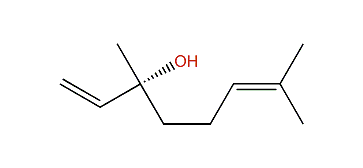
| (R)-2,6-Dimethyl-2,7-octadien-6-ol |
| Formula: | C10H18O |
| CAS#: | 126-91-0 |
| MW: | 154.25 |
[MS]
[ Kovats ]
|
|
Species utilize (R)-2,6-Dimethyl-2,7-octadien-6-ol in its chemical communication system
| Heteroptera, Pyrrhocoridae, Pyrrhocorinae | |
| Dysdercus cingulatus |
P
¦Category of the chemical signal
| A - | Attractant |
| Al - | Allomone |
| K - | Kairomone |
| P - | Pheromone |
| Sy - | Synomone¦ |
|
¦(*) indicates that compound is active¦
|
Red cotton stainer |
| Dysdercus koenigii |
P
¦Category of the chemical signal
| A - | Attractant |
| Al - | Allomone |
| K - | Kairomone |
| P - | Pheromone |
| Sy - | Synomone¦ |
|
¦(*) indicates that compound is active¦
|
Red cotton bug |
| Dysdercus similis |
P
¦Category of the chemical signal
| A - | Attractant |
| Al - | Allomone |
| K - | Kairomone |
| P - | Pheromone |
| Sy - | Synomone¦ |
|
¦(*) indicates that compound is active¦
|
|
| |
| Hymenoptera, Agaonidae, Agaoninae | |
| Ceratosolen solmsi marchal |
A
¦Category of the chemical signal
| A - | Attractant |
| Al - | Allomone |
| K - | Kairomone |
| P - | Pheromone |
| Sy - | Synomone¦ |
|
¦(*) indicates that compound is active¦
|
|
| |
| Coleoptera, Bruchidae, Bruchinae, Bruchini | |
| Bruchus rufimanus |
A
¦Category of the chemical signal
| A - | Attractant |
| Al - | Allomone |
| K - | Kairomone |
| P - | Pheromone |
| Sy - | Synomone¦ |
|
¦(*) indicates that compound is active¦
|
Broad bean weevil |
| |
| Coleoptera, Cerambycidae, Spondylidinae, Tetropiini | |
| Tetropium cinnamopterum |
A
¦Category of the chemical signal
| A - | Attractant |
| Al - | Allomone |
| K - | Kairomone |
| P - | Pheromone |
| Sy - | Synomone¦ |
|
¦(*) indicates that compound is active¦
|
Eastern larch borer |
| Tetropium fuscum |
A
¦Category of the chemical signal
| A - | Attractant |
| Al - | Allomone |
| K - | Kairomone |
| P - | Pheromone |
| Sy - | Synomone¦ |
|
¦(*) indicates that compound is active¦
|
Brown spruce longhorn beetle |
| |
| Coleoptera, Scarabaeidae, Melolonthinae, Rhyzotrogini | |
| Holotrichia parallela |
A
¦Category of the chemical signal
| A - | Attractant |
| Al - | Allomone |
| K - | Kairomone |
| P - | Pheromone |
| Sy - | Synomone¦ |
|
¦(*) indicates that compound is active¦
|
|
| Holotrichia parallela |
P
¦Category of the chemical signal
| A - | Attractant |
| Al - | Allomone |
| K - | Kairomone |
| P - | Pheromone |
| Sy - | Synomone¦ |
|
¦(*) indicates that compound is active¦
|
|
| |
| Coleoptera, Tenebrionidae, Tenebrioninae, Triboliini | |
| Tribolium castaneum |
Al
¦Category of the chemical signal
| A - | Attractant |
| Al - | Allomone |
| K - | Kairomone |
| P - | Pheromone |
| Sy - | Synomone¦ |
|
¦(*) indicates that compound is active¦
|
Red flour beetle |
| |
| Homoptera, Aphididae, Aphidinae, Aphidini | |
| Aphis fabae |
K
¦Category of the chemical signal
| A - | Attractant |
| Al - | Allomone |
| K - | Kairomone |
| P - | Pheromone |
| Sy - | Synomone¦ |
|
¦(*) indicates that compound is active¦
|
Black bean aphid |
| |
| Lepidoptera, Geometridae, Ennominae, Boarmiini | |
| Ectropis obliqua |
Al
¦Category of the chemical signal
| A - | Attractant |
| Al - | Allomone |
| K - | Kairomone |
| P - | Pheromone |
| Sy - | Synomone¦ |
|
¦(*) indicates that compound is active¦
|
|
| |
|